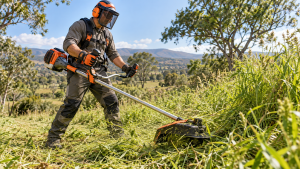
When grass has moved beyond ordinary lawn maintenance and into waist-high weeds, dense vegetation or large areas that need regular clearing, a lightweight trimmer may no longer be the right machine for the job.
That is where a professional brushcutter earns its place.
Professional machines are designed for heavier vegetation, longer working sessions and repeated use across larger properties. But choosing one is not simply a matter of buying the model with the biggest engine.
Power matters, but so do cutting equipment, balance, vibration levels, harness design, weight and the type of vegetation you actually need to clear.
GSR Outdoor’s brushcutter range includes Husqvarna machines designed around effective cutting, adjustable ergonomics and comfortable operation for demanding work.
When Do You Need a Professional Brushcutter?
A grass trimmer and a brushcutter can look similar, but they are built for different workloads.
Grass trimmers are primarily intended for lighter work such as lawn edges, grass around obstacles and routine finishing. Brushcutters offer more power and can use heavier cutting equipment for thicker grass, weeds and demanding clearing work.
A professional brushcutter starts to make sense when you regularly maintain:
- Large residential properties
- Estates and complexes
- Smallholdings
- Farms
- Road verges
- Parks and public spaces
- Commercial landscapes
- Areas with thick grass or established weeds
- Ground that is allowed to become heavily overgrown between cuts
The difference is not only what the machine can cut once. It is whether it can keep doing that work comfortably and reliably throughout repeated, demanding use.
Start With the Vegetation, Not the Engine Size
Before comparing specifications, look at what you actually need to cut.
Long but relatively soft grass
For long grass and moderate weeds, you may not need the most powerful professional machine available.
A mid-range professional brushcutter with an appropriate trimmer head or grass blade can offer a better balance between performance, weight and fuel consumption.
Thick grass and tougher weeds
Dense vegetation requires more cutting power, particularly when the machine needs to maintain blade speed under load.
Husqvarna’s current professional range includes models such as the 535-class machines for frequent thick grass and weed cutting, moving up to 45 cc machines intended for heavier agricultural, horticultural and utility applications.
Heavy brush and difficult clearing
Once the work moves beyond grass into woody weeds, thick brush or demanding utility clearing, you may need a higher-output machine and cutting attachment designed for that material.
This is where professional brushcutters in the upper end of the range become more relevant.
The key lesson is simple: buy for the vegetation you encounter regularly, not the worst patch of grass you have ever seen.
How Much Engine Power Do You Need?
Engine size can be useful when comparing brushcutters, but it should not be read in isolation.
Husqvarna’s South African professional petrol range currently spans models from approximately 1 kW of output through to machines producing around 2.8 kW. Cutting widths also vary from roughly 45 cm to more than 50 cm depending on the model.
For example:
- Lighter professional models may produce around 1 to 1.4 kW
- Heavy-duty 45 cc machines can produce around 2.1 to 2.2 kW
- Larger full-time-use machines can reach around 2.8 kW
More power generally gives the machine greater ability to maintain cutting performance in dense vegetation.
But a more powerful machine is also typically heavier.
That is why professionals should think in terms of power-to-weight ratio, not simply maximum output.
If two machines can handle your normal workload, the lighter and better-balanced option may be considerably more comfortable over an eight-hour working day.
Cutting Equipment Matters as Much as Power
A professional brushcutter becomes much more versatile when it can use the correct cutting attachment for the vegetation.
Different applications may call for:
- Trimmer line
- Grass blades
- Brush blades
- Saw blades, where supported by the specific machine
Trimmer line works well for grass and general maintenance, while blades are better suited to tougher vegetation. Husqvarna also offers professional models specifically configured for different combinations of grass, weeds and brush.
Always use cutting equipment approved for the particular brushcutter.
The fact that an attachment physically fits is not enough reason to use it.
Why Professional Users Should Care About Comfort
If you use a brushcutter for twenty minutes at home, a slightly awkward machine may simply be annoying.
If you use it for several hours a day, poor ergonomics become a productivity problem.
Professional machines should therefore be evaluated for:
- Balance
- Harness quality
- Handlebar position
- Vibration
- Machine weight
- Control layout
- Starting effort
- Ease of adjusting the machine to the operator
Husqvarna’s professional brushcutter range specifically places emphasis on anti-vibration systems, high handlebar towers, balance and supportive harness systems to reduce fatigue during longer working sessions.
GSR also notes that its Husqvarna brushcutters use adjustable, ergonomically designed handlebars and longer shafts to support comfortable handling and reach.
These features may sound secondary when reading a specification sheet, but they become very important once someone has been operating the machine for several hours.
A Good Harness Is Not an Optional Extra
A proper harness distributes the machine’s weight across the operator’s shoulders and body rather than leaving the arms to carry the full load.
For professional users, this can significantly affect comfort and control.
Some larger Husqvarna professional brushcutters are supplied with advanced harness systems specifically designed for extended working periods. The 545RXT and 555RXT, for example, are positioned around full-time professional use with ergonomic harness systems and vibration reduction.
When comparing professional machines, pay attention to the harness included with the machine rather than viewing it as an afterthought.
Weight Becomes More Important the Longer You Work
Powerful brushcutters can become surprisingly heavy.
Current Husqvarna professional petrol machines range from lighter options around the mid-6 kg range through to larger machines weighing roughly 9 kg before fuel and cutting equipment are added.
That difference may not feel dramatic when you lift the machine in a showroom.
After several hours of clearing, it certainly can.
The right question is not:
“Which machine is lightest?”
It is:
“Which machine gives me enough cutting performance without carrying more weight than the work requires?”
Occasional Residential Use vs Professional Use
This distinction is one of the most important parts of the buying decision.
Occasional residential use
A homeowner who clears long grass a few times a year generally does not need the same machine as a landscaping team using equipment every day.
For occasional use, priorities may include:
- Easy starting
- Lower weight
- Straightforward operation
- Enough power for seasonal overgrowth
- Easier storage
Paying for additional professional capacity that you never use may not provide much value.
Large-property and professional use
For landscapers, estates, municipalities, farms and large-property owners, the calculation changes.
Repeated heavy work places greater demands on:
- Engine durability
- Cooling
- Drive components
- Cutting equipment
- Harness systems
- Vibration control
- Fuel efficiency
- Servicing
Husqvarna describes its professional brushcutters as machines designed for full working days, with high cutting capacity combined with balance and ergonomic features intended to maintain productivity.
If a brushcutter is part of your livelihood, buying the correct professional machine is less about luxury and more about uptime.
Think About Fuel Efficiency Too
For occasional home use, small differences in fuel consumption may barely register.
For a landscaping business operating multiple machines every day, they add up.
GSR’s Husqvarna brushcutter range features X-TORQ engine technology, which GSR says can reduce exhaust emissions and improve fuel efficiency compared with older engine designs.
Fuel efficiency should not be the only reason you choose a machine, but it becomes more relevant as operating hours increase.
Starting Shouldn’t Become Part of the Workout
Professional operators may start and stop equipment several times during a working day.
Features that make starting easier can therefore save more than frustration.
GSR notes that many Husqvarna brushcutters use an auto-return stop switch, which automatically returns to the start position once the machine has been switched off.
Higher-end models may also include features such as Smart Start or AutoTune, depending on the machine.
Individually these features can seem minor.
Across hundreds of starts during a working season, minor conveniences stop feeling minor.
Don’t Forget Personal Protective Equipment
Professional brushcutting can throw stones, sticks and other debris at significant speed.
Appropriate PPE should form part of the equipment decision from the beginning.
Depending on the application, this may include:
- Eye or face protection
- Hearing protection
- Gloves
- Protective footwear
- Long trousers
- Appropriate protective clothing
GSR carries dedicated PPE products alongside its outdoor equipment range.
Before clearing any area, also inspect the ground for wire, stones, bottles and other objects that could become dangerous projectiles.
Servicing Matters More When the Machine Earns Its Keep
Professional equipment does not only need power. It needs uptime.
A brushcutter that fails during a busy landscaping contract can cost considerably more than the repair itself.
GSR recommends regular brushcutter servicing, particularly for commercial and professional machines. Its servicing process includes inspection of fasteners, fuel and lubrication systems and other wear items required to keep the equipment operating correctly.
Professional users should build servicing into the ownership plan rather than waiting for something to break.
A Simple Professional Brushcutter Buying Checklist
Before choosing a machine, ask:
- What vegetation will I cut most often?
- How many hours will the machine run each week?
- Do I need line, a grass blade or heavier cutting equipment?
- Is the machine’s power appropriate for the workload?
- Can I comfortably carry its weight for the required working period?
- Does the harness distribute the weight properly?
- Are vibration and handle position comfortable?
- Can the machine be serviced and supported locally?
- Will replacement cutting equipment and parts be easy to source?
- Am I buying for my normal workload rather than an occasional extreme job?
Those questions will usually tell you more than engine capacity alone.
Choose a Brushcutter for the Work You Actually Do
For large properties and professional landscaping, the best brushcutter is not automatically the biggest model available.
A machine that is too small may struggle constantly in thick vegetation. A machine that is unnecessarily large may add weight, fuel use and operator fatigue without delivering a meaningful advantage.
Start with the vegetation, working hours and cutting attachments you need. Then compare power, weight, ergonomics and long-term support.
GSR Outdoor supplies professional brushcutters from Husqvarna and can help match the machine to residential, agricultural, landscaping and commercial applications.
For customers who rely on their equipment regularly, GSR’s Somerset West workshop also provides servicing and technical support to help keep the machine working when it matters.